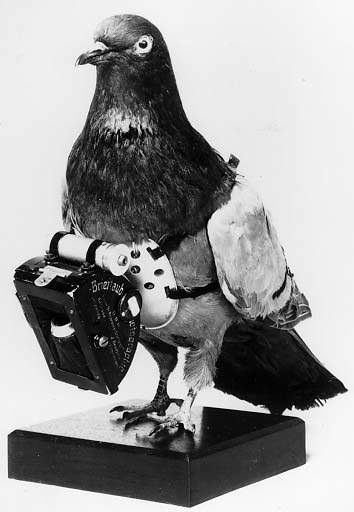

We here at Pigeons of War want to wish you all a very Happy Presidents’ Day! Presidents’ Day is an American holiday observed annually on the third Monday of February. It’s a day set aside to celebrate the achievements of America’s presidents. So it seems appropriate to write about President Wilson’s accomplishments today–the renowned homing pigeon of World War One, that is.
President Wilson was born in France around 1917 or 1918 in a loft under the care of the United States Army Signal Corps. In mid-September 1918, he received his first assignment: accompanying Lieutenant-Colonel George S. Patton’s Tank Battalions as they rode to the Saint-Mihiel salient. Patton had participated in simulated war games involving pigeons and was eager to deploy them in battle. The Tank Battalions carried a total of 202 birds into action, losing 24 of them in the process. President Wilson performed superbly during the Saint-Mihiel Offensive. He carried important messages from the tanks to his loft so rapidly, he received commendations from the Signal Officer of the First Corps.
As the fighting at Saint-Mihiel subsided, President Wilson was transferred to the Meuse-Argonne Offensive and placed with an infantry unit stationed near Grandpre. From September 26th to November 11th, 90 percent of the Signal Corps’ birds served in some of the bloodiest fighting in the War. On the morning of October 5th, President Wilson’s unit encountered enemy fire. He was released with a note requesting artillery support. On his way back to the loft, a piece of shrapnel sailed through the air and tore off his left leg. Nevertheless, President Wilson persisted and managed to return to his loft with the message, traveling over twenty kilometers in twenty-one minutes in spite of heavy fog and rain. What makes this flight all the more incredible was that it was only his second flight over the Meuse-Argonne Front.
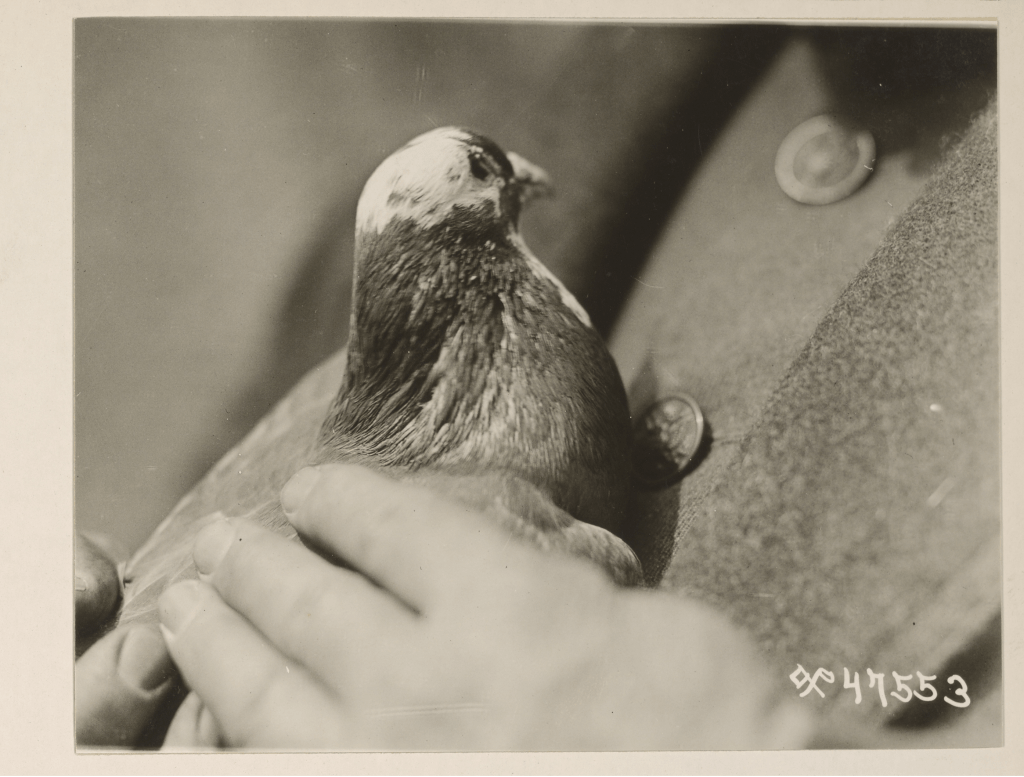

While President Wilson was nursed back to health, his commanding officer, Lieutenant John L. Carney, wrote up an official citation memorializing his deeds, which was widely reprinted in American media. Doughboys in Europe and their families back home read about the bird’s courage under fire. His story–along with those of other Army pigeons–captivated the public.
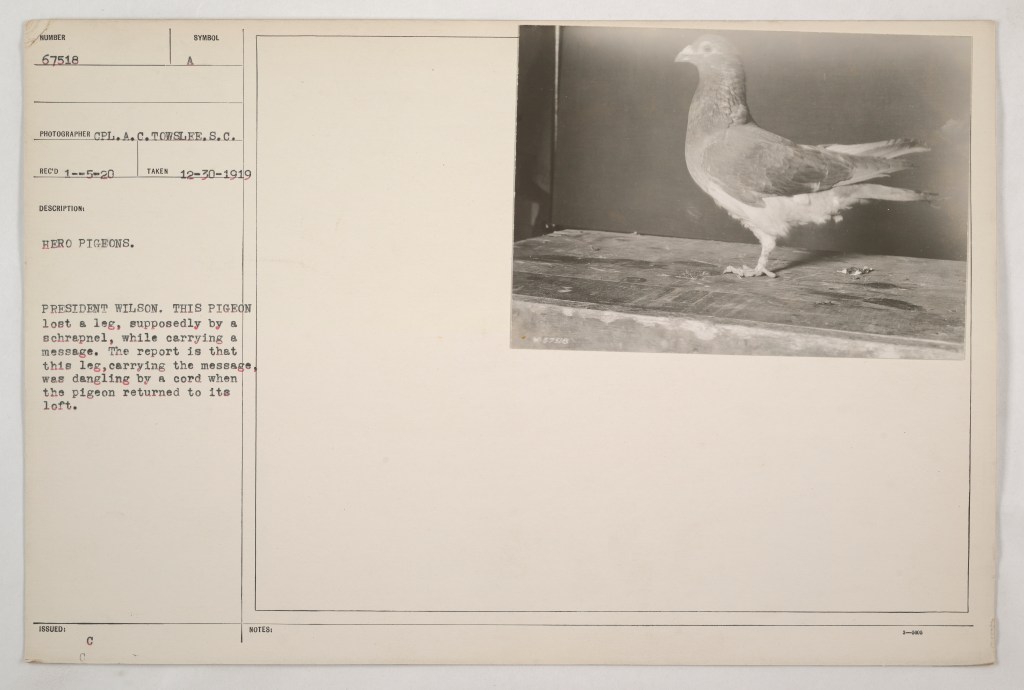
After the War ended, President Wilson immigrated to the U.S. in 1919. He was an instant celebrity. He toured the country, appearing at conventions where he served as a tangible reminder of the sacrifices homing pigeons had made during the Great War. In January 1920, he and some of his Army buddies were the guests of honor at the annual Madison Square Garden Poultry and Pigeon Show. Accompanied by a cadre of body guards–the Chief of the Pigeon Officer of the Army and his staff–President Wilson quickly attracted the crowd’s attention. “All eyes strained to see President Wilson,” declared the American Pigeon Journal. It was noted that he was still in good physical condition, but the gravity of his injury was noticeable to all present:
He does not walk but hops in company with many others that came with him including a Homer with one eye shot out and Fritz, a German Staff bird wearing an Imperial Band, that was captured at St. Mihiel with a German message.
President Wilson eventually retired from the limelight and moved to the U.S. Army Signal Corps Breeding and Training Center at Fort Monmouth, New Jersey. It was a mostly quiet life, although he did take time to star in a film. After nearly a decade, his health began to fail. Reports of his decline were transmitted to the Signal Corps’ headquarters, “as if he were a wounded general,” one local newspaper observed. He died on June 8, 1929.
Officials decided to preserve his body and put it on display. When these plans were reported by the media, a ten-year old schoolgirl wrote to the Secretary of War, imploring him to inter President Wilson at the Arlington National Cemetery. The Secretary wrote back, claiming regulations prevented him from honoring the child’s wish. “I am sure, however, you will agree with me,” he wrote, “that by placing the pigeon in our military museum it will help to keep alive the memory of his historic and heroic deeds.”
Ultimately, President Wilson was stuffed and mounted and kept at Fort Monmouth for nearly a year. On March 22, 1930, his body was shipped to the Smithsonian Institution, escorted by a captain of the Signal Corps. There, he joined his fellow veteran Cher Ami, the hero of the Lost Battalion, and was featured as an exhibit for over seventy years. In 2008, the U.S. Army acquired President Wilson–he is currently on display at the Pentagon, just outside the Army Chief of Staff’s office.
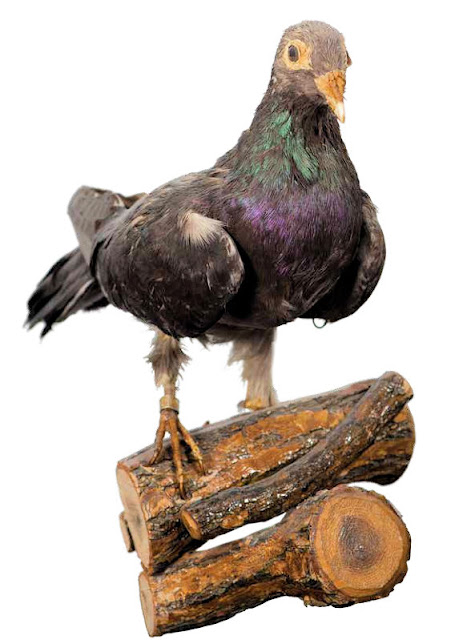
If you find yourself in Washington, D.C. next Presidents’ Day, you should definitely take a trip to the Pentagon and see President Wilson in person. We can’t think of a better way of honoring the legacy of America’s presidents than by paying tribute to one of their most prominent namesakes.
Sources:
- Blazich, Frank A. “Feathers of Honor: U.S. Army Signal Corps Pigeon Service in World War I, 1917–1918.” Army History, No. 117 at 43-44.
- McLaughlin, Elizabeth. “Meet the Hero Carrier Pigeon That Saved US Troops During a WWI Battle 100 Years Ago.” ABC News, 5 Oct. 2018, available at https://abcnews.go.com/International/meet-hero-carrier-pigeon-saved-us-troops-wwi/story?id=58233076.
- “Mounted War Bird Sent to Museum,” The Daily Record, Mar. 22, 1930, at 3.
- “One of Our Bird Veterans of the War,” Popular Science, Vol. 97, No. 6, December 1920, at 68.
- “One of the Trio of Famous War Birds Saved Many Lives,” The Record, July 2, 1929, at 8.
- “Pigeon Heroes of World War Attract Attention of Hundreds at County Fair,” The Bulletin, Oct. 19, 1923, at 7.
- “Pigeons with Records in War Are on Exhibit,” The Indianapolis News, Jan. 5, 1920, at 6.
- President Wilson Attends Madison Square Garden Poultry and Pigeon Show,” American Squab Journal, January 1920, Vol. 9, No. 1, at 163.
- “War Bird Heroes on Visit to City,” The Starry Cross, June 1919, Vol. 28, No. 6, at 92.
- War Birds Filmed for Sound Picture,” The Daily Record, April 13, 1929, at 3.
- “Winged Hero Finds Friend,” The Ridgewood Herald, Jul. 2, 1929, at 1, 6.
 Pigeons of War
2 responses to “Happy Presidents’ Day from President Wilson!”
[…] of War, we’ve devoted several articles to famous war pigeons. We’ve written about Gustav and President Wilson, for instance, both of whom spent their formative years in the military. However, thousands of […]
LikeLike
[…] second Poilu of fame was hatched in an American loft in France in the final year of the War. Like President Wilson, the Poilu first saw combat in mid-September 1918, when he was selected to accompany […]
LikeLike