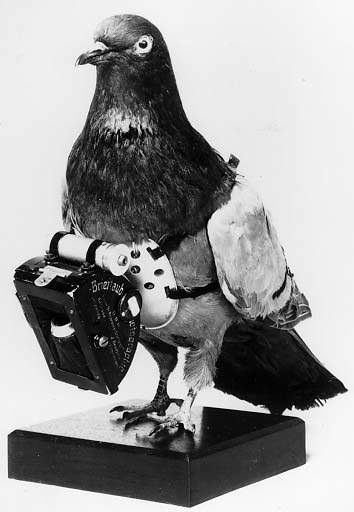

The United Kingdom’s Royal Air Force (RAF) enjoys the honor of being the world’s first independent air force. For over 100 years, the RAF has protected Britain’s skies and air space from harm, playing a major role in the Second World War and the Cold War. Few people, however, are aware of the RAF’s predecessors during the First World War, the Royal Naval Air Service (RNAS) and the Royal Flying Corps, which merged in 1918. This week, we take a look at the RNAS and how it relied on pigeons during the Great War.
On July 1st, 1914, the Admiralty of the United Kingdom officially created the RNAS. Envisioned as the Royal Navy’s (RN) analogue to the Army’s Royal Flying Corps, the RNAS had three primary objectives: maritime reconnaissance, patrolling for enemy ships and U-boats, and attacking enemy coastal territory. The newly formed unit assumed ownership over “[a]ll seaplanes, aeroplanes, airships, seaplane ships, balloons, kites, and any other type of aircraft that may from time to time be employed for naval purposes.” All naval personnel with aircraft experience, both active and reserve, were immediately reassigned to the RNAS. Within just a few weeks, the RNAS boasted 93 aircraft, six airships, two balloons, and 727 officers and enlisted men.

Barely a month after its launch, the RNAS found itself preparing to take part in the largest European engagement since the days of Napoleon. After several weeks of fighting, an opportunity emerged for the RNAS to test its reconnaissance and offensive capabilities. Military officials wanted to bombard the Imperial German Navy’s airship bases on the Heligoland Bight, a bay within the North Sea, to prevent future zeppelin attacks on the British mainland. But the bases were out of range for British-based aircraft, so a crew from the RNAS was recruited to aerially reconnoiter the Heligoland Bight and bomb any zeppelin sheds spotted in the vicinity. On Christmas morning 1914, seven RNAS seaplanes took off from a group of seaplane tenders stationed near the bay. The seaplanes flew for over three hours, surveying the area and bombing a few minor shore installations. Although the results obtained by the RNAS were meager, the Raid on Cuxhaven—as it came to be known—demonstrated the potential of a unified sea-and-air attack.
The RNAS also spent considerable time patrolling for enemy U-boats, which were sinking thousands of merchant ships bound for French and British ports. Over the course of the war, the RNAS searched over 4,000 square miles in the North Sea, the English Channel, and along the coast of Gibraltar for submarines. Although the seaplanes’ guns generally weren’t sufficient to sink submarines—only one German U-boat was sunk by a British plane unassisted by warships during the conflict—the pilots could relay the subs’ locations to the RN’s surface fleet.

An issue frequently encountered in the RNAS was how to communicate with pilots who were stranded in the sea. Seaplanes and flying boats were too small to accommodate a wireless set until 1917. Even after the planes received wireless units, the devices were useless in the event of engine failure. As readers of this blog will recognize, this is the exact emergency scenario for which a pigeon service is ideal. But the RN had phased out its pigeons in 1908, viewing the birds as antiquated with the rise of wireless telegraphy. RNAS officials were inspired to reinstitute a naval pigeon service following an episode involving their French counterparts. On June 8th, 1916, an injured pigeon arrived at Saint-Pol-sur-Mer bearing a message from a downed seaplane near Ostend and Zeebrugge along the Belgian coast. A French destroyer traveled to the crash site, only to encounter a German torpedo boat attempting to haul the seaplane away. A skirmish broke out and the seaplane was ultimately lost.
Even though the French had failed to recover the seaplane, a British RNAS station in Dunkirk learned of this episode and was impressed with its results. An inquiry led to the donation of a few well-trained birds, which were rapidly put to use. Just two days later, two RNAS seaplanes flying 4,000 feet over Zeebrugge released pigeons with accompanying despatches revealing the area was enemy free. The pigeons successfully returned to their Dunkirk lofts bearing good tidings. On June 20th and 24th, pigeons brought news to Dunkirk of shot-down RNAS seaplanes, facilitating their rescues.

With such an auspicious start, it soon became standard operating procedure for each RNAS flight crew to carry a basket of pigeons with them on every journey. Writing nearly 90 years later, Henry Allingham—the last surviving veteran of the RNAS—explained the process:
[W]e didn’t have radio. We had pigeons which we carried in a basket. . . . Some of our people who were adrift in the drink could be there for up to five days, and they used to let the pigeons go. They would fly back to the loft at the station, and a search party would be sent out to look for them. As a general rule, after five days of searching, they’d give up and the men were lost.
RNAS pilots and observers received specialized training from pigeon experts before they ever handled a bird. It was especially important that they be instructed on how to avoid harming pigeons during aerial releases. “The liberation of a pigeon from a seaplane in flight requires a certain amount of dexterity,” remarked one contemporary publication, “as the bird is liable to be caught in the slip-stream of the airscrew and dashed against the tail group.”

The RNAS maintained flocks of pigeons at the principal naval air stations on the mainland. Although the RNAS owned some 1,000 birds outright, it also received three thousand birds from donors as diverse as King George V. When released at sea, the donated pigeons flew back to the original owners home, where the owner would telegraph the message’s contents to the proper authorities. The bird would eventually be returned to the nearest RNAS station and reunited with its crew. Until then, the owner was expected to feed and care for the bird without compensation from the RNAS.
The RNAS’s pigeon program was wildly successful. In spring 1918, it was claimed that RNAS pigeons had carried over 1500 messages. Newspaper accounts regaled audiences with tales of pigeons saving RNAS servicemembers from watery graves. In one widely reported story, a seaplane pilot, forced to make an emergency landing off the coast of Kent, released a pigeon at 7:24 a.m. The bird returned to its loft by 8:00 a.m. and a trawler was enroute within 30 minutes to rescue the pilot. An even more impressive feat occurred when four pigeons arrived at a station one after the other, telling the story of a fierce dogfight over the North Sea fragment-by-fragment. However, sometimes the news brought back via pigeon wasn’t pleasant. Once, a pigeon returned with a message written in German declaring that the RNAS pilot and seaplane had been captured.

The most famous story of a rescue by an RNAS pigeon occurred on September 5th, 1917. That morning, two RNAS planes flew out of the Yarmouth naval air station, heading toward the North Sea. They were in search of German zeppelins, which had been operating near Terschelling Island, north of the Netherlands. A total of six men were present: four in a seaplane and two in a biplane. Halfway into the flight, they spotted two zeppelins and opened fire. The dirigibles attained the upper-hand, riddling the English planes with bullets, while German ships fired anti-aircraft shells from below. As the Germans left the scene, the biplane plummeted into the ocean, its engine destroyed. The seaplane was still airborne, though it suffered from a broken wing and a misfiring engine. It landed near the biplane and its crew brought the two men aboard. Although the six men were unharmed, the seaplane failed to become airborne after repeated attempts. They opted to release four pigeons over three days with news of their calamity. Only one pigeon managed to make the 50-mile flight back to the Norfolk coast, Pigeon N.U.R.P/17/F.16331, but it died immediately from exhaustion. Reading its message, naval officials learned of the men’s location and rescued them; not a single life had been lost thanks to the pigeon’s sacrifice.
At its peak, the RNAS comprised 55,066 personnel, 2,949 aircraft, 103 airships and 126 coastal stations. Yet, by 1918, British war planners were keen to consolidate the nation’s military aircraft and personnel under one branch. On April 1, 1918, the RNAS merged with the Royal Flying Corps to become the RAF. The contributions of the RNAS’ birds weren’t forgotten, however. In November 1918, 13 former RNAS birds were displayed at a London event; between all of them, they had saved a dozen lives and many downed aircrafts. In April 1919, the RAF issued an official list of pigeons who had distinguished themselves in wartime service on flying boat and seaplane operations. Meanwhile, Pigeon N.U.R.P/17/F.16331 was preserved in a glass case bearing the inscription, “A Very Gallant Gentleman;” it can still be seen to this day at the UK’s RAF Museum.

Sources:
- Flying Boats over the North Sea.” RAF Museum, 1 Feb. 2021, https://www.rafmuseum.org.uk/blog/flying-boats-over-the-north-sea/;
- Milford, Humphrey, The Periodical, Vol. 13, No. 145, June 15, 1928, at 75.
- O’Flaherty, Patrick, “Peaceful Pigeons in Modern Warfare,” The Montreal Star, Mar. 2, 1918, at 17.
- “Pigeons Bring Help to Our Fighting Men,” The Buffalo News, Sep. 26, 1919, at 19.
- “R.A.F. Pigeon Service,” The Aeroplane, Vol. 16, No. 2, Jan. 15, 1919, at 306.
- “Royal Naval Air Service,” Flight, Vol. 6, No. 26, June 26, 1914, at 686-89.
- Simkin, John. Royal Naval Air Service. Spartacus Educational, https://spartacus-educational.com/FWWrnas.htm.
- Sondhaus, Lawrence, The Great War at Sea, at 264 (2014).
- “The Gallant Pigeon That Saved Six WW1 Airmen Lost in the North Sea.” Look and Learn, 30 May 2012, https://www.lookandlearn.com/blog/18494/the-gallant-pigeon-that-.
- “Wireless Signals,” The Nottingham Evening Post, Feb. 4, 1908, at 3.
- “WW1 Flying Boat Crew.” RAF Museum, 1 Feb. 2021, https://www.rafmuseum.org.uk/blog/ww1-flying-boat-crew/.
 Pigeons of War
2 responses to ““Very Gallant Gentlemen:” The Pigeons of the Royal Naval Air Service, 1916-1918 A.D.”
Enjoyed reading this article particularly as the first photograph shows my father, Capt, Edgar Andrew Bolton RNAS holding the box containing the Very Gallant Pigeon. I believe the incident of receiving the pigeon happened on his 4th day of being stationed at RNAS Great Yarmouth
LikeLiked by 1 person
Thanks for reading! What a wonderful story—so glad you shared it with us.
LikeLike