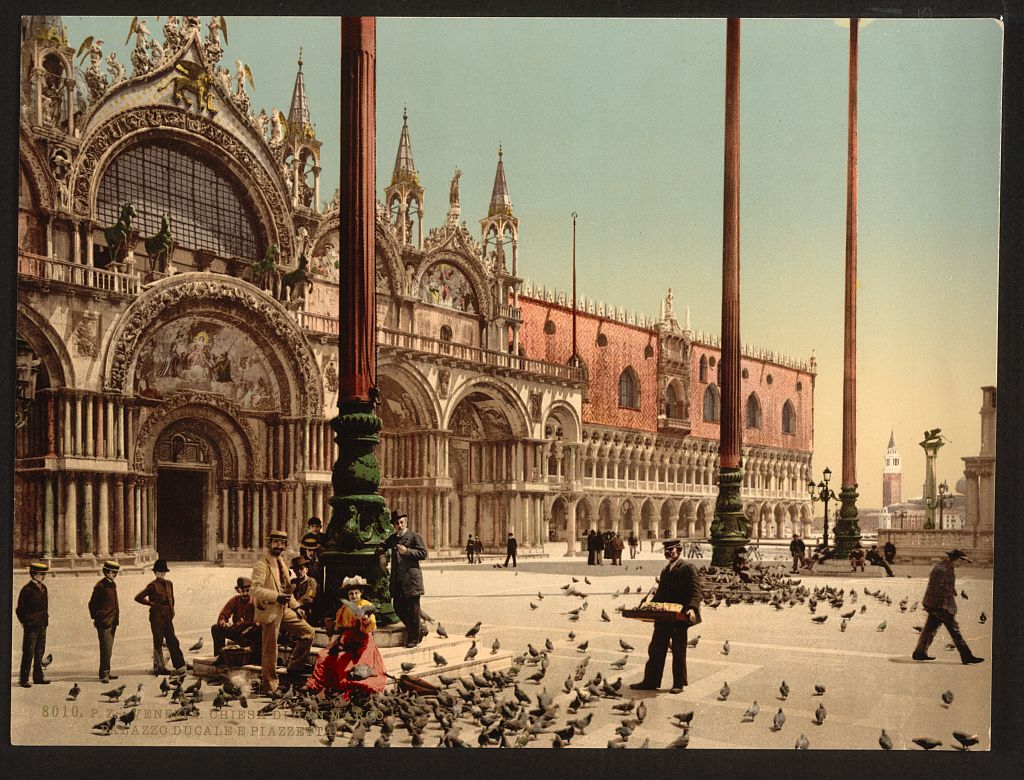
Venice is famous for its pigeons. They’re everywhere, and tourists expect to see them. A special haven for Venice’s pigeons is Piazza San Marco, the city’s principal public square. Before the 20th century, San Marco’s pigeons were highly regarded, even considered sacred. Several origin stories have been advanced for these pigeons, but, for our purposes, we at Pigeons of War favor one legend attributing a martial heritage to these birds. The most detailed account of this myth has been reproduced below:
On the heels of the Fourth Crusade, the Republic of Venice purchased the island of Crete from Boniface, the Marquis of Montferrat, in 1204 after promising to support his acquisition of the Kingdom of Thessalonica. Not everyone was happy with this transition. Some of the native population in Candia, the island’s most important port, resisted their new overlords. Raniero Dandolo, son of the Venetian Doge Enrico Dandolo and an Admiral of the Venetian fleet, initiated a blockade of Candia in response. The blockade was supported by a Genoese fleet under the command of Enrico Pescatore, the Count of Malta. Long-time rivals, Venice and Genoa were ostensibly allies at this point. Yet, some of Dandolo’s officers noticed that a flock of pigeons were flying towards the Genoese ships. Intrigued, Dandolo ordered for some of the pigeons to be captured the next time they flew in that direction. When they appeared again, Dandolo’s men shot down 7 or 8 of them with arrows. Upon inspection, each pigeon had a letter from the Candiotes to the Genoese secured to its wing.
Dandolo stormed Candia the next night, driving out the Genoese. Soon, he had control of the whole island. While exploring the now vacant governor’s palace, the Venetians found a number of pigeons. Dandolo shipped them to Venice with news of his victory. Grateful for the role the pigeons played in Dandolo’s conquest, city officials treated the birds with great honor, allowing them to dwell at Piazza San Marco.

Over time, San Marco’s flock of pigeons multiplied into an enormous colony. A 19th century tourist described their dominion over the Piazza and the city at large:
They rest at night in the laces of the palaces and the cornices of the great cathedral, on triumphant columns and arches and in the airy arcades of the Campaniles. They nestle with the winged lions and dart noiselessly through the churches. They brush the sacred altars and the tombs of kings and doges and bishops. They walk the marble pavements in groups and in hundreds, unmolested among throngs of passers. They play with the children and fly up on your cafe table for their share of the cake or water.
Undoubtedly, this increase was facilitated by a religious tradition dating back to the Middle Ages. Every Palm Sunday, the priests of San Marco released imported pigeons with weights tied to their wings over the Piazza. An Easter gift from the Doge to his citizens, most of those birds were easily caught by Venetians and eaten. The few survivors, however, were allowed to reside at San Marco, as they were believed to have earned the protection of the saint. After centuries of cross-breeding, the pigeons had developed into a stunning bird by the 19th century. One observer described their traits in almost rhapsodic terms:
[They] are black, and white (or grey) with pink eyes and red feet. A beautiful green collaret surrounds the throat; the body is quite white under the wings. Some of them have white tails; whiter than the snow which falls on the summit of the Apennines; and opal or topaz eyes, which change their tints a thousand times a day.
Meanwhile, the city’s generosity toward the Piazza’s pigeons persisted. Every day at 2 pm, an official rang a bell, alerting the birds that it was supper time. Without fail, the pigeons would swarm San Marco in search of the official’s grain. Aside from providing them food, Venetian officials also imposed strict laws guaranteeing the birds’ safety. If anyone harmed a pigeon, he or she would be arrested. For first-time offenders, they’d be fined; for repeat offenders, a trip to prison awaited them. Venetian citizens, for their part, viewed San Marco’s pigeons as sacred—it was not uncommon for individuals to leave legacies for their care or request saintships for them in the local calendar.

In 1848-49, the Piazza’s pigeons, not unlike their ancestors, found themselves recruited for wartime service. A possession of the Austrian Empire since 1797, Venice revolted in 1848, forming its own state, the Republic of San Marco. The Austrians eventually initiated a blockade of the Venetian Lagoon and bombarded the city. Throughout the blockade, the feeding of the Piazza’s pigeons continued unabated, even though the city’s population was starving. Some of them even carried messages out of the city in an end-run around the blockade. It was only in the last days of the conflict that a few individuals resorted to the unthinkable and ate some of San Marco’s pigeons. In August 1849, the Republic surrendered to the Austrians, becoming a Hapsburg province for 17 more years.
By the modern era, the city’s pigeons had lost their luster. Tourists still loved them, and a thriving industry had popped up, supplying visitors with corn to feed the birds. City officials, however, were frustrated that the city’s pigeon population had ballooned to 60,000, even though the city could only accommodate about 2,400 of them. Pigeons were blamed for damaging art and architecture—their highly acidic poop allegedly caused structural damage as it seeped into fissures, while their constant scratching and pecking damaged marble monuments. They also, per officials, spread disease and attacked the customers of hoteliers, restaurateurs, and other merchants. Pigeon advocates chalked most of these issues up to pollution and reckless tourists.
Much to the chagrin of tourists, in 1997, Venice banned the feeding of pigeons everywhere except for at Piazza San Marco. Naturally, this caused the city’s pigeons to congregate en masse at the Piazza. In 2008, the city finally banned the feeding of pigeons at San Marco. Violators would face a €500 fine. While the ordinance merely annoyed tourists seeking pictures with the pigeons, it carried with it serious economic consequences for the Piazza’s 19 licensed bird seed vendors. Before the ban, vendors had offered tourists 3.5 ounces of corn for $1.30. On a good day, a vendor could clear more than $100. Outraged by the ban, the vendors argued that most of the damage to the Piazza was caused by smog. Vendor Gianni Favin noted the pigeons’ legacy at San Marco: “There have been pigeons in St. Mark’s Square for a thousand years,” he angrily remarked to the press. “To see the piazza without pigeons is like seeing a tree without its leaves.”
Vendors and tourists weren’t the only figures angered at the ban—animal rights groups vigorously protested as well. Shortly after the ban’s enactment, a “band of animal lovers armed with skull-and-crossbones flags” cruised up to the Piazza in their speedboat and hurriedly scattered 20 pounds of birdseed for the pigeons. They struck twice at dawn and once at midday, daring the police to fine them. But the stunts did not dissuade city officials from lifting the ban.
In the 14 years since the ban was implemented, mass colonies of pigeons continue to reside at Piazza San Marco. Some tourists still feed them on the sly, even though the fine has now been raised to €700. Having been a fixture since the 1200s, it seems that the legacy of San Marco’s pigeons will be a hard one to eradicate.

Sources:
- Ali, Shafqat. St Mark’s Square Pigeons Refuse to Budge. The Nation, 9 July 2018, https://www.nation.com.pk/10-Jul-2018/st-mark-s-square-pigeons-refuse-to-budge.
- Barry, Colleen. “Venice Confronts Its Vermin: 40,000 Pigeons.” NBCNews.com, NBCUniversal News Group, 11 Sept. 2006, https://www.nbcnews.com/id/wbna14784143.
- De Roo, V. La Perre, Monographie des pigeons domestiques, at 268 (1883).
- Ginsborg, Paul, Daniele Manin and the Venetian Revolution of 1848-49, at 361, n. 75 (1979).
- Imboden, Durant. Pigeons of Venice. Venice for Visitors, https://europeforvisitors.com/venice/articles/pigeons_of_venice.htm.
- Perl, Henry, Venezia, at 63 (1894).
- “The Pigeons of Venice,” The Brooklyn Daily Eagle, Dec. 23, 1868, at 4.
- “The Sacred Pigeons of Venice,” The Newbernian, August 16, 1879, at 4.
- Wilkinson, Tracy. “Animal Lovers Battle Venice over Piazza Pigeons.” Boston.com, The Boston Globe, 8 June 2008, http://archive.boston.com/news/world/articles/2008/06/08/animal_lovers_battle_venice_over_piazza_pigeons/.
- Wood, Sim. “Is It Okay to Feed Pigeons in Venice?”, Bird Buddy Blog, 2 Aug. 2022, https://blog.mybirdbuddy.com/post/pigeons-of-venice.
 Pigeons of War
One response to “The Military Heritage of Venice’s Pigeons”
[…] View Source […]
LikeLike