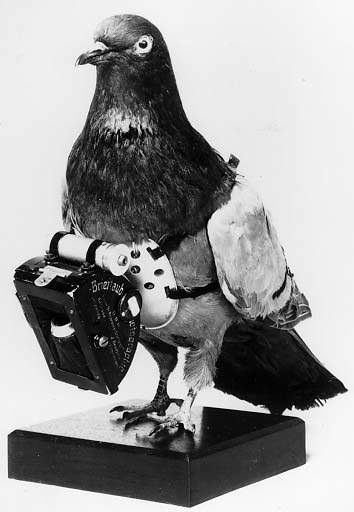

In the final months of the Great War, the German Army frequently left behind their pigeons as they beat a hasty retreat from encroaching Allied forces. Many of these abandoned birds, as we’ve previously written about, were eagerly adopted by the Americans, who incorporated them into breeding programs back stateside. But Germany’s Army was not the only branch to have its own pigeons. Indeed, the German Navy’s pigeon program dated back to the 1880s. Did any of its birds become POWs? This week, we’ll take a look at a German naval pigeon that jumped ship while American vessels were laying down mines in the North Sea.
On April 6th 1917, the United States officially declared war on Germany. The US entered the fray at a crucial juncture—German U-boats were attacking merchant ships at a merciless rate. That month alone, submarines sank approximately 800,000 tons worth of ships bound for French and British ports. If this rate continued unabated, Allied officials feared that the Central Powers would attain victory within a year, as the diminished Allied merchant fleet would not be able to supply the necessary materiel needed to win the War.
The US Navy realized that these increasing submarine attacks meant that troop transport ships carrying American soldiers and supplies to the Western Front were liable to be sunk. As early as April 15th, naval planners circulated a memorandum exploring the possibility of installing mines in the North Sea. The British Navy had previously placed mines in the English Channel, which had caused the U-boats to head north around Scotland. A barrage placed across the North Sea ideally would close this alternative route, thereby preventing U-boats from traveling to Atlantic shipping lanes. After some internal debate, US naval officials discussed the proposal at the Allied Naval Conference in September 1917, where the British Admiralty expressed support. By November 1917, both country’s governments had signed off on what became known as the North Sea Mine Barrage.

As envisioned, the plan called for the following objective:
A barrier of high explosives across the North Sea – 10,000 tons of TNT -, 150 shiploads of it, spread across an area 230 miles long by 25 miles wide and reaching from near the surface to 240 feet below – 70,000 anchored mines each containing 300 pounds of explosive, sensitive to a touch, barring the passage of German submarines between the Orkneys and Norway.

The first US naval ships arrived off the coast of Scotland in May 1918. In June, the British and American navies set to work laying mines in agreed upon zones. The American minelaying fleet consisted of aging protected cruisers and former commercial steamships. British destroyers accompanied them as they worked, providing cover via smokescreen to conceal the ships’ activities.

The fleet labored all summer, laying dozens of miles of mines at a time. One day, amidst a fierce gale, the sailors spotted a red-checkered pigeon fluttering wearily up in the sky. It landed on the deck of one of the ships, exhausted and beaten down from the wind and rain. Crew members noticed that the pigeon’s leg band bore a code indicating it belonged to the Germany Navy, which had several pigeon stations along the North Sea. It was a young bird, having hatched earlier that year. At under a year old, the pigeon likely was lost in a training exercise, but maybe it had intentionally defected, fed up with life at sea. Regardless of its motivation, the pigeon was now a POW—when the ship returned to port, the pigeon was promptly handed over to the US Army Signal Corps.
After five months of work, the American and British minelayers finished the barrage at the end of October 1918. The War ended a few weeks later. A total of around eight U-boats sank thanks to the North Sea Mine Barrage. Attention now shifted to minesweeping, which took most of 1919.
Meanwhile, the Signal Corps decided that the pigeon—now christened Old Anchor—would be used in an experimental breeding program at Fort Monmouth, New Jersey. Old Anchor headed to his new home in 1919, placed under the care of Thomas Ross, the Fort’s pigeon expert. As he took to his surroundings, Old Anchor proved to be quite the lothario. He fathered many of the Fort’s best-performing pigeons over the years. From 1928 through 1933, many of his sons and daughters regularly won 600- and 700-mile races. One descendant—named General George S. Gibbs, in honor of the Signal Corps’ then-commander—won the gold cup for best bird in America at a pigeon show held in New York City in 1929. At another New York show in January 1934, 20 of Old Anchor’s descendants won a total of fourteen first prizes, four seconds, and two thirds in addition to five trophy cups.
Old Anchor became a long-term resident at Fort Monmouth, seeing his 21st birthday in 1939. But that same year, various old age ailments started catching up with him. He lingered for a few months, then passed away on April 5th, 1939. A beloved figure at this point, no excess was spared for his interment. Personnel at the Fort constructed a special wooden casket and a military funeral with full honors was held for him, including a 21-gun salute. It was a fitting tribute to a pigeon who had greatly improved the quality of the Army’s birds.

Sources:
- Belknap, Reginald, The Yankee Mining Squadron, at 17 (1920).
- “German Pigeon Dies at Fort Monmouth,” The Daily Record, Apr. 6, 1939, at 1.
- The US Navy Department, The Northern Barrage and Other Mining Activities, (1920).
- “Two Veterans Pass,” United States Army Recruiting News, August 1939, Vol. XXI, No. 8, at 7.
 Pigeons of War