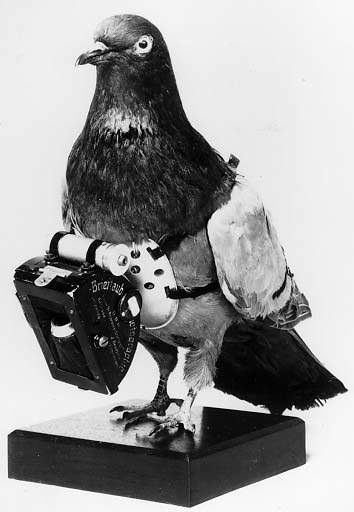

Since the end of the Second World War, most of the world’s militaries have decommissioned their pigeon services. A few, however, have held onto their birds. In this ongoing series, we’ll take a closer look at these holdouts.
For the past two weeks, we’ve explored the world’s last military pigeon services. So far, we’ve learned that the Uruguayan and French armies still boast active lofts. Unlike their renowned ancestors, these army birds have no military obligations. The birds are frequently released at military demonstrations and public events, serving as living reminders of their countries’ past military practices. In reading about these lofts, one might be tempted to think that pigeons have no real place in a modern military.
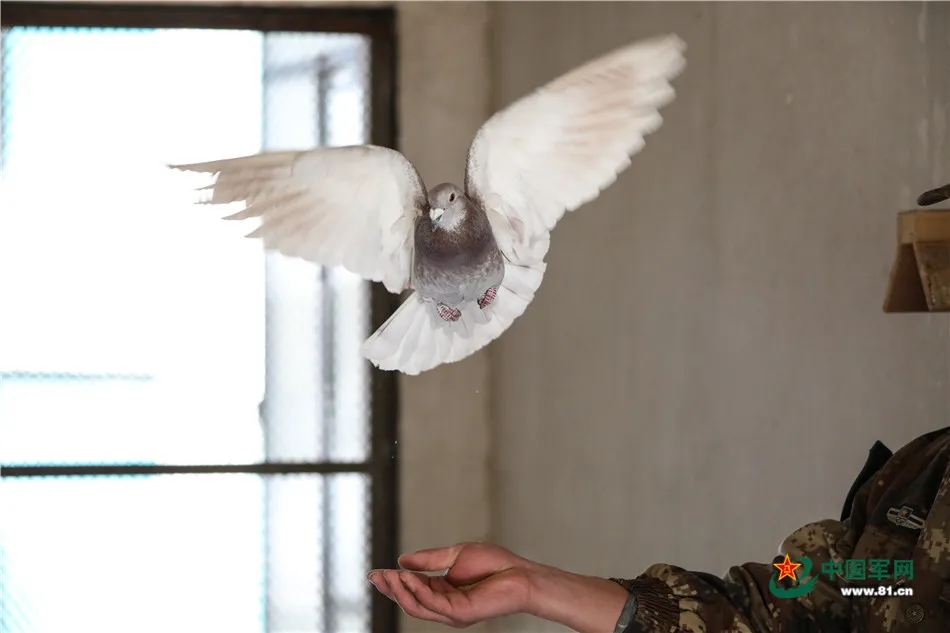
This week, we look at a country that defies this assumption: China. Rather than downsize its pigeon service, China’s military has gone the opposite route, adding thousands of birds throughout the 2010s.
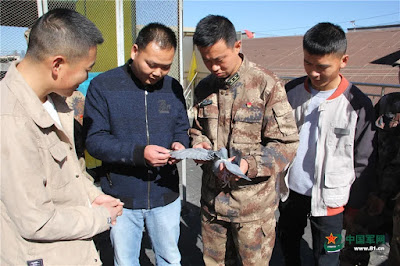
China’s use of pigeons in its militaries dates back to at least the Ming dynasty (1368 to 1644 C.E.). During that era, the nation’s armies used pigeons as couriers. The seeds of the modern pigeon service, however, were sown in the mid-20th Century. In 1937, an American officer, Lieutenant Claire Lee Chennault, traveled to China to set up the Flying Tigers, an aerial defense unit operated by American pilots to deter Japan’s invasion of the country. In setting up this program, he imported hundreds of pigeons from the US for use in communicating with forces on the ground, given that radio communication was often not possible. Following numerous trips over the Burma Road and across the Hump, the Flying Tigers disbanded at the end of the Second World War, leaving their birds behind in China.
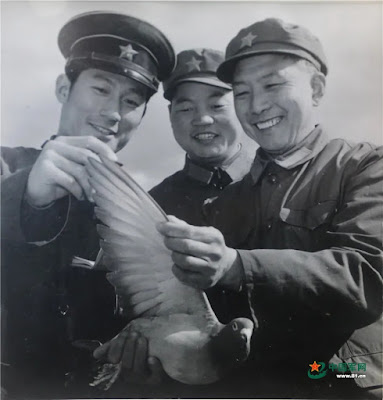
Meanwhile, on October 1, 1949, Mao Zedong proclaimed the establishment of the People’s Republic of China. The People’s Liberation Army (PLA) set up its own pigeon service a year later. Realizing the value of the Flying Tigers’ pigeons, officials secured these battle-hardened veterans for their nascent loft. In 1957, a series of pigeon units were set up on military bases around the country to serve as backup in case communications were disrupted. At its peak, 11 such units existed, one for each of the then-existing 11 military regions. Over the subsequent years, trainers developed an intense program for the PLA’s birds. A record was set in 1982, when a pigeon flew from Shanghai to Kunming, a distance of 1,336 miles, over 9 days. Impressed with his service, officials embalmed his body after he passed away—it is still on display.
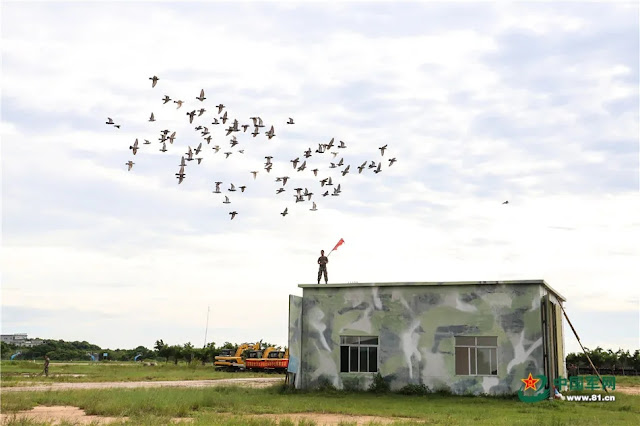
By 2000, most of the country’s pigeon units had been shut down. Only a single military loft was left at a PLA communications garrison in Kunming in the southern Yunnan Province. Numbering a few hundred, these birds were trained to carry despatches into mountainous regions and islands in the South China Sea.

In 2010, military officials decided to reinvigorate the PLA’s pigeon service. 10,000 pigeons were to be added to the service over time, forming a “reserve pigeon army” capable of providing support to the military’s communication network in the event of a total blackout brought on by war. The pigeons would be assigned to communications bases across China’s remote and mountainous southwestern region, near the Himalayan mountains. Training exercises would focus on increasing the birds flying speed to 75 miles an hour and getting them to carry loads weighing up to 3.5 ounces.

To promote the new program, Chinese military officials embarked on a media blitz. Stories appeared in Chinese and Western media throughout 2011, featuring input from officers. “These military pigeons will be primarily called upon to conduct special military missions between troops stationed at our land borders or ocean borders,” air force military expert Chen Hong informed viewers of China Central Television. Chen Chuntao, the officer in charge of the PLA’s pigeons, explained the rationale for the expansion. “[Pigeons are the] most practical and effective short and medium distance tool for communications if there is electromagnetic interference or a collapse in our signals.”
Most media articles in the West reporting on these developments treated the subject jocularly. However, the news greatly alarmed French pigeon fancier and lawmaker Jean-Pierre Decool. Fearing that France would be left in the dust, he contacted the Ministry of Defense, stressing the need for the Army to increase its pigeon stocks. The Maréchal des Logis in charge of the French Army’s dovecote doubted the veracity of the reports. “It is true Chinese pigeon fanciers are paying a lot of money to buy pigeons, but no one knows if this is for the army.”

Tracking the pigeon program’s progress over the past decade is difficult—few stories have surfaced since the initial flurry of reports. Nevertheless, in recent years, some have argued that the pigeons aren’t being trained merely for emergency communication services. Instead, several incidents near the Indo-China border—an area in which China maintains several territorial claims—point to their involvement in a possible spy network.

In May 2017, villagers in the Anjaw District of Arunachal Pradesh—a state in Northeastern India bordering China—encountered a number of pigeons bearing Chinese letters and numbers on their leg bands. The locals turned the birds over to the local authorities, but they proved unable to decode the leg bands. While the pigeons did not have any spy cameras or transmitters, the authorities could not rule out that the birds were being used “for surveillance of frontier areas and townships.” Pigeons with similar leg band markings have been found in other nearby towns as well as in Uttarakhand, the northernmost state in India, in the years since. Indian Army personnel at border stations observing these pigeons insist they have unique, repetitive flight patterns. This has led to claims that the pigeons are being used to map the landscape in search of routes that could be used by Chinese agents to infiltrate India. A pigeon can swoop in low and obtain low-altitude imagery, whereas a drone or piloted aircraft would attract unwanted attention if it were to do so. Proponents of this theory assert that a Chinese pigeon caught in the village of Niti had been fitted with a micro-camera. Chinese media have dismissed such concerns as groundless and ludicrous, noting that Indian authorities have made similar claims about Pakistani pigeons in the past.


Thus ends our examination of the world’s remaining military pigeon services. While Uruguay and France have consigned their military pigeons to ceremonial uses, China’s pigeons are still a force to be reckoned with, even in the Information Age. Will militaries still use pigeons in the 22nd Century? Only time will tell.
Sources:
- “A ‘Chinese’ Pigeon Creates Excitement in Arunachal.” The New Indian Express, 22 May 2017, https://www.newindianexpress.com/nation/2017/may/22/a-chinese-pigeon-creates-excitement-in-arunachal-1607798.html.
- Arpi, Claude. “Avian Intrusions Over the Red Line.” Indian Defence Review, 24 May 2017, http://www.indiandefencereview.com/spotlights/avian-intrusions-over-the-red-line/
- “China Army Unit of the Day: Military Communication Pigeon Unit.” China Defense Blog, 16 June 2020, https://china-defense.blogspot.com/2020/06/china-army-unit-of-day-military.html.
- China Dismisses, India Panics over Prospect of Chinese ‘Spy Pigeon’ .” People’s Daily Online, 24 May 2017, http://en.people.cn/n3/2017/0524/c90000-9219832.html.
- Hanks, Jane. “France’s Army Platoon of Carrier Pigeons Is One of Its Kind in Europe.” The Connexion, 17 June 2021, https://www.connexionfrance.com/article/Practical/Work/France-s-army-platoon-of-carrier-pigeons-is-one-of-its-kind-in-Europe.
- Jiang, Chengcheng. “China’s Most Secret Weapon: The Messenger Pigeon.” Time, 2 Mar. 2011, http://content.time.com/time/world/article/0,8599,2049569,00.html.
- Mong, Adrienne. “China Raises Tiny Reserve Army. Really Tiny.” Behind the Wall, NBCUniversal News Group, 4 July 2011, http://behindthewall.msnbc.msn.com/_news/2011/07/04/6665128-china-raises-tiny-reserve-army-really-tiny.
- Moore, Malcolm. “China Trains Army of Messenger Pigeons.” The Telegraph, 2 Mar. 2011, https://www.telegraph.co.uk/news/worldnews/asia/china/8356921/China-trains-army-of-messenger-pigeons.html.
- Saxena, Nitin. “Signs China’s Espionage Network in India Is Cracking.” The Taiwan Times, 26 July 2020, https://thetaiwantimes.com/signs-chinas-espionage-network-in-india-is-cracking/.
- Turner, Mia. “China’s Prized Pigeons Rule the Roost.” The New York Times, 12 Jan. 2000, https://www.nytimes.com/2000/01/12/style/IHT-chinas-prized-pigeons-rule-the-roost.html.
 Pigeons of War