Since the end of the Second World War, most of the world’s militaries have decommissioned their pigeon services. A few, however, have held onto their birds. In this ongoing series, we’ll take a closer look at these holdouts.
At the dawn of the Twentieth Century, Uruguay’s military joined the worldwide pigeon arms race inaugurated by the Franco-Prussian War and established its own service. A possible source of inspiration was its neighbor to the south, Argentina, which boasted 7 military lofts connecting Buenos Aires with the Andes by 1901. The exact date is unclear, but at some point before 1904, the Uruguayan Army founded a dovecote in Montevideo. Dubbed El Palomar Militar Central, the loft housed 300 birds and was overseen by an engineering battalion responsible for telegraph operations. The service soon expanded to the center of the country, with a loft in the city of Paso de los Toros, then northwards to the border cities of Rivera and Melo. These lofts, which were supplied by the Montevideo dovecote, housed 80 birds a piece. In addition to stationary lofts, the Army also raised pigeons in mobile coops, which were assigned to certain units.
The first director of the military’s Pigeon Service was an Argentinian fancier. Under his watch, he imported birds of Belgian extraction from Buenos Aires and developed training programs to link the central loft with the northern lofts. By linking the lofts, the military ensured that Montevideo would remain in contact with the northern departments in the event of a disaster or warfare.
To send messages, soldiers were provided with blank forms and advised to fill them out with a pen. Despatches were to be written like a telegram, with the author using simple, unambiguous words economically. When finished, soldiers were instructed to insert the message into a rubber or aluminum tube and affix it to the pigeon’s leg. In the event a tube could not be located, soldiers were advised to wrap the despatch in lead paper and tie it directly to the bird’s leg—this would protect the message from the elements.

In these early years, the bird’s abilities were tested during the Revolution of 1904, a brief, yet bloody civil war between the government and a rival political party. The Army’s pigeons showed their merit during this engagement, helping keep units in contact with one another. In a 1906 address before the legislature, President José Batlle y Ordóñez lauded the pigeons’ accomplishments during the insurrection. To date, this has been the only conflict in which the military’s birds have participated.
While the Army developed its Pigeon Service, civilians began forming fancier groups, the first of which appeared in the ‘20s. The military opted to foster a relationship with these groups– they helped transport civilian birds to racing competitions and even returned any lost pigeons recovered by soldiers to their owners. A law formalizing this relationship was enacted in 1943; it placed all pigeon racing activities under the authority of the Ministry of Defense. Fanciers desiring to race their birds were required to register their birds with the Ministry and provide information about the size and pedigree of the flock, with annual updates. The Ministry still regulates pigeon races to this day. “We raise the pigeons, but we are not the owners: the owner is the State because we depend on the Ministry of Defense, which still considers them a strategic resource,” remarked Jorge Risso, president of the Ariel Pigeon Society, in a 2008 interview.
During the latter-half of the century, the focus of the Pigeon Service shifted away from providing emergency communication services to performing ceremonial duties. The northern lofts were shut down in 1958, while soldiers at the Montevideo loft found themselves training their birds for racing competitions organized by fancier groups. Throughout the ‘70s, the Army released the pigeons at public events staged by the military or the state. As the pigeons participated in more races, the facilities at the Montevideo were remodeled in the ‘80s to better prepare the birds for these events. The remodeling must’ve worked, as the Army’s pigeons have won numerous prizes in subsequent years.

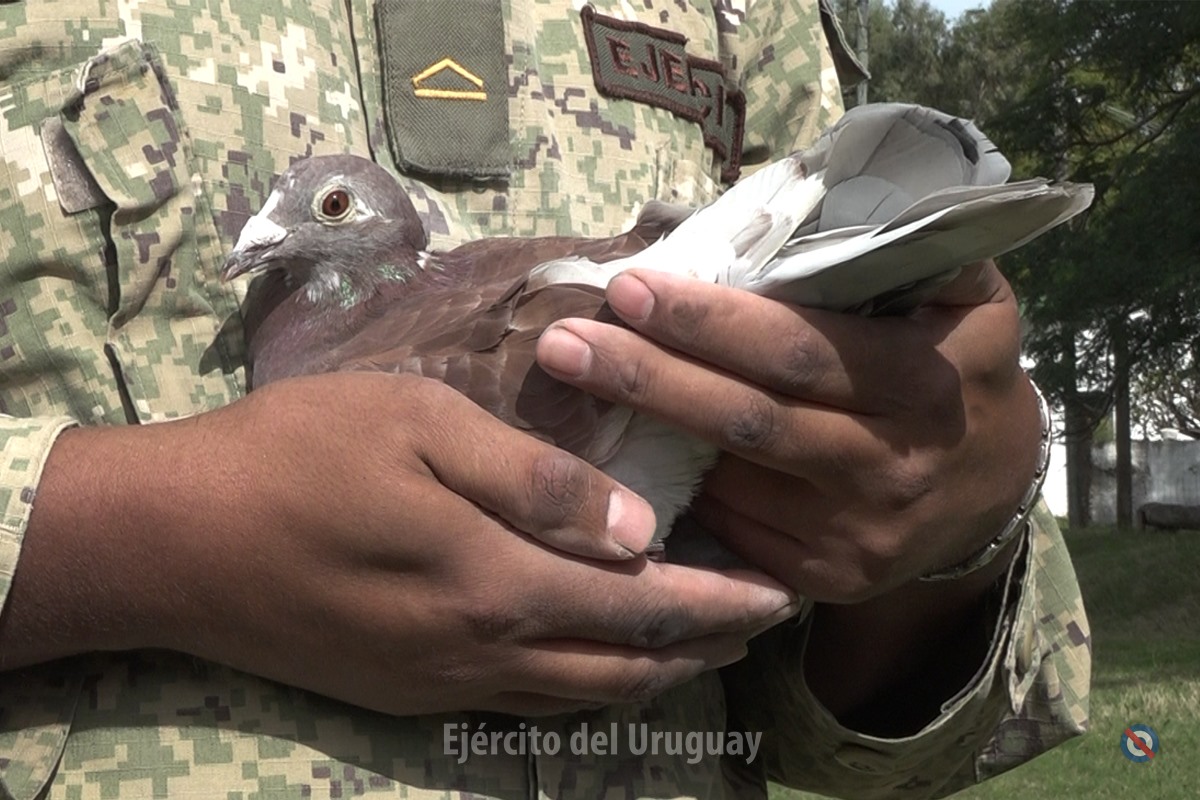
These days, the Uruguayan Army currently maintains a flock of 145 pigeons distributed across three coops in the Peñarol neighborhood of Montevideo. Responsibility for the birds’ care lies with the Communications Brigade No. 1, a unit tasked with maintaining the military’s electronic communications system. A non-commissioned officer, Sargento Carlos Benítez, oversees the birds, training them daily with 90-minute flight exercises. This regimen has paid off, as the Army’s pigeons have racked up some impressive records. Benítez asserts that his crew can fly up to 1,000 kilometers in a day at speeds as fast as 120 kph. The birds have made successful flights from the border city Bella Union and Porto Alegre, Brazil, traveling over 600 kilometers within just a few hours. To keep the birds in line, Benítez relies on a type of pigeon known as a pouter. In Uruguay, the bird is called a buchón—a slang term meaning informant—owing to its large crop. These pigeons can’t fly very high, so they sit out Benítez’s flight exercises. Instead, they perch on top of the coop, waiting for their loftmates to return. When the buchón spots a returning bird, it helps escort the pigeon back to its loft.


No longer needed for communication services, the Montevideo lofts now serve as living history, a reminder of how pigeons once formed an integral part of military operations. Educating the public is a primary goal. To that end, the birds have frequently been featured on television, with Army officials giving viewers glimpses of the inner-workings of the lofts in 2017 and 2019. The birds have also been brought to schools for students to witness history in action. On one occasion, children at a rural school wrote messages that were carried by the birds back to Montevideo, where the military faxed back copies. Outside of educational presentations, the Army allows for its pigeons to participate in events hosted by public and private entities. They are frequently released at football matches at the Centennial Stadium or at the celebrations of the cult of San Cono that are held annually in the city of Florida. And, of course, the birds still compete in racing competitions.
Nevertheless, there is always the possibility that Uruguay’s electrical grid could be compromised by a natural disaster or an act of terrorism. If such an event were to happen, the Uruguayan Army’s Pigeon Service would be ready, willing, and able to rise to the call of duty. Montevideo’s birds could bring information into the capital city, while the Ministry of Defense could tap into the nation’s network of fanciers and use their pigeons to restore communication with the nation’s other regions. These outcomes are not only possible, but probable, given that the Army has officers and enlisted personnel experienced in handling and training pigeons. For these reasons, the Uruguayan Army’s decision to maintain a flock of pigeons well into the 21st Century has been a wise one.

Sources:
- Batlle y Ordóñez, José, Mensaje del Presidente de La Republica, at 117 (1906).
- Corbin, Henry C. & Simpson, W. A., Notes of Military Interest for 1901, at 237 (1901).
- Las Palomas Mensajeras: Un Deporte Que Es Arte y Pasión. LARED21, 16 July 2008, https://www.lr21.com.uy/comunidad/320319-las-palomas-mensajeras-un-deporte-que-es-arte-y-pasion.
- LLoyd, Reginald, Impresiones de la República del Uruguay en el Siglo Veinte, at 178 (1912).
- Melgar, Pablo. “Palomas Que Desafían a Twitter.” Diario EL PAIS Uruguay, El País Uruguay, 9 Mar. 2017, https://www.elpais.com.uy/informacion/palomas-desafian-twitter.html#.
- Ministerio de Guerra y Marina, Reglamento General y Regimen Interno de Los Palomares Militares, at 23-24 (1926).
- “Palomar Militar De Uruguay .” Las Palomas Mensajeras, https://laspalomasmensajeras.tripod.com/id38.html.
 Pigeons of War